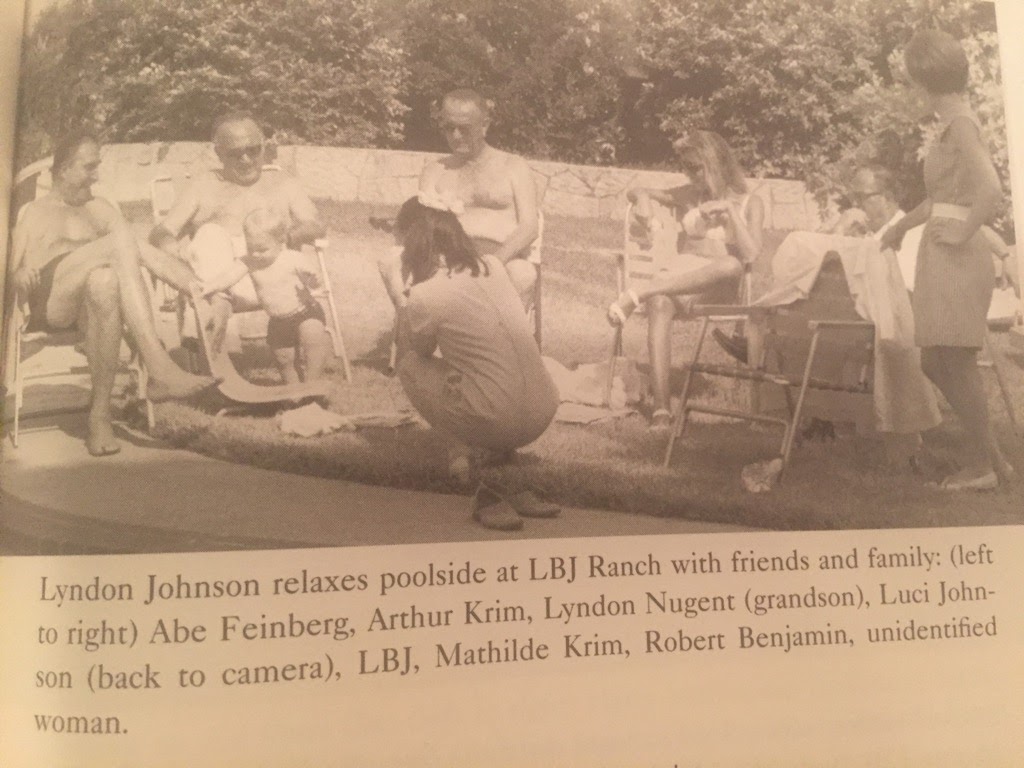
Grace Halsell, a former staff writer for Lyndon Johnson, explains that in the White House of Lyndon Johnson only ardent Zionist Jews had access to and influence with LBJ and this was especially true in the Six Day War of 1967.
https://www.wrmea.org/1993-june/how-lbj-s-vietnam-war-paralyzed-his-mideast-policymakers.html
Washington Report on Middle East Affairs, June 1993, Page 20:
How LBJ's Vietnam War Paralyzed His Mideast Policymakers
by Grace Halsell
In the summer of 1967, I was a
staff writer for President Lyndon B. Johnson at the White House. I was aware of
that year's Middle East crisis but, like most Americans, understood little
about it other than the fact that it involved Jews and Arabs. In that year I
did not know a single Arab, and possibly LBJ did not either. Like most
Americans, I was pro-Israel, Israel having been sold to most all of us as the
underdog.
Everyone around me,
without exception, was pro-Israel. Johnson had a dozen or more close associates
and aides who were both Jewish and pro-Israel. There were Walt Rostow at the
White House, his brother Eugene at State, and Arthur Goldberg, ambassador to
the United Nations. Other pro-Israel advisers included Abe Fortas, associate
justice of the Supreme Court; Democratic Party fundraiser Abraham Feinberg;
White House counsels Leo White and Jake Jacobsen; White House writers Richard
Goodwin and Ben Wattenberg; domestic affairs aide Larry Levinson; and John P.
Roche, known as Johnson's intellectual-in-residence and an avid supporter of
Israel.
“Everyone
around me, without exception, was pro-Israel.”
I did not "know," but could sense, that events of
great portent were transpiring. I heard rumors of CIA Director Richard Helms
sending a warning to LBJ that the Israelis were about to attack, and the
president getting word from Moscow that if the Israelis attacked any Arab
country, the Soviets would go to that nation's defense.
I could see the comings
and goings of Abe Fortas and Arthur Goldberg, and I knew that Walt Rostow, in
particular, had close Israeli connections, and met frequently with Israeli
Embassy Minister Ephraim (Eppy) Evron.
On occasion I saw a strikingly attractive blonde woman who, I
learned, was an ardent supporter of Israel and a woman of whom the president was fond. Her background
sounded like material from a spy novel. She was born Mathilde Galland in 1927 in Italy, where she was reared as
a Roman Catholic. Then, when her family returned to her father's birthplace in
Switzerland, she became a Lutheran.
While a student in Geneva, she fell in love with a young
Bulgarian Jew, David Danon, who had been brought up in Palestine and exiled by the British for his
association with the Irgun Zvai Leumi, a Jewish terrorist group led by Menachem
Begin. Danon was studying to become a medical doctor, but spent most of
his time recruiting and carrying out secret Irgun operations throughout Western
Europe.
In later interviews with former Time reporter Donald Neff, Mathilde said that as a
teenager she saw Danon as a dashing and heroic figure, an activist dedicating
his life to the founding of a Jewish state in Palestine. He was a personal
friend of the Stern Gang terrorists, led by Yitzhak Shamir, who killed British
resident minister Lord Walter Moyne in Cairo during World War II, and the Irgun
terrorists who blew up the King David Hotel in Jerusalem in 1946, with heavy loss of life. As bloody as these actions were,
Mathilde said, she saw them as heroic. They represented the depth of the
convictions of Danon and the Irgunists—and drew her to them.
Mathilde became so
enamored of the Jewish struggle and of Danon's daring undercover operations in
Europe that she converted to Judaism and married Danon. Then she, too, became
an Irgun agent.
Reporter Neff, in his
book entitled Warriors for Jerusalem: The Six Days
That Changed the Middle East, documents Mathilde's role as a young "gun-runner" for the
Jewish terrorist group. "As a seemingly innocent petite and pretty blonde out for
a bicycle ride along Switzerland's borders," wrote Neff, "she in
reality was taking messages and explosives into neighboring France and Italy—to
be passed on to the Irgunists.
Five years after the creation of Israel obviated the need for
pretty blonde gunrunners, Mathilde received a Ph.D. in genetics at the
University of Geneva in 1953. She and
Danon then moved to Israel, where she became a cancer researcher at the
Weizmann Institute. After the birth of a daughter, she and Danon separated. While still at Weizmann,
however, she met and later married the rich—and 20 years her senior—Arthur
Krim, a motion picture executive who became finance chairman for the Democratic
National Committee.
American Jews such as
Krim and Abraham Feinberg—a New York banker and the first Jew to become a
prominent moneyraiser in presidential campaigns—were by then bringing in well
over half of the Democratic Party's funds. Thus it was natural that such fund-raisers
would become very important to many Democratic candidates—and particularly to
the leader of the Democratic Party, Lyndon B. Johnson.
LBJ often invited the
Krims to his Texas ranch. There also were many instances in which Arthur and
Mathilde were guests at the White House, and other times when, for many days
running, Mathilde—without her husband—was a guest there. The Krims built a
house near the LBJ ranch known as Mathilde's house, and Johnson often traveled
there by helicopter.
ADVICE AND COUNSEL
The Krims, as well as other Jewish Americans who were closely
associated with Johnson, advised and counseled him on the events leading up to
the Six-Day War of June 1967.
On the Memorial Day weekend in May 1967, Mathilde and her husband were guests
at the LBJ ranch. On arrival at the ranch, Johnson learned that the
Soviets had warned the U.S. that if Israel attacked an Arab state, the Soviets
would go to the aid of that state. The State Department was preparing a message
for LBJ to send to Israel.
While awaiting the draft message, Johnson got behind the wheel
of his Lincoln Continental and took Mathilde and Arthur Krim for a drive over
the hill country. They
were at a neighbor's house when an aide brought Johnson a message drafted by
the State Department for Israeli Prime Minister Levi Eshkol. It relayed to
Israel Moscow's warning that "if Israel starts military action, the Soviet
Union will extend help to the attacked party."
After reassuring Eshkol of America's interest in Israel's
safety, the draft message cautioned: "It is essential that Israel not take
any preemptive military action and thereby make itself responsible for the
initiation of hostilities." The president strengthened the warning by adding two words so that the
sentence read, "It is essential that Israel JUST MUST NOT take any
preemptive military action. . ."
On June 3, Johnson
traveled to New York to deliver a speech at a Democratic Party fund-raising
dinner. He moved on to a $1,000-a-plate dinner dance, sponsored by the
President's Club of New York, whose chairman was Arthur Krim. While at the
table, fund-raiser Abe Feinberg leaned over the shoulder of Mathilde Krim,
seated next to Johnson, and whispered: "Mr. President, it [Israel's
attack] can't be held any longer. It's going to be within the next 24
hours."
On June 4, Johnson went to the home of his close adviser and
friend, Justice Abe Fortas. The following day, June 5, Rostow woke Johnson with
a phone call at 4:30 a.m. "War has broken out," Rostow said. The
Israelis had attacked Egypt and Syria.
Mathilde Krim was a guest
at the White House and, before going to the Oval Office, and apparently before
waking Lady Bird or notifying anyone else, Johnson dropped by the bedroom where
Mathilde was sleeping and gave her the news: "The war has started."
At 7:45 a.m., Johnson talked—for the first time—on the hot line
with Moscow. Soviet Premier Aleksi Kosygin expressed the hope that the United
States would restrain Israel. Both leaders vowed to work for a cease-fire.
On that day—June 5, 1967—I walked the White House corridors as
the telephone lines and news tickers recorded developments of the first morning
of the war that would change the Middle East. I learned that in the war's first hours, Israeli planes
had destroyed the air forces of both Egypt and Syria on the ground.
UNCONCEALABLE GLEE
Several U.S. officials in
a State Department Operations Room briefing could not conceal their glee over
Israel's successes. With a wide smile, Eugene Rostow said, "Gentlemen,
gentlemen, do not forget that we are neutral in word, thought and deed."
At the State Department's noon briefing on June 5, press
spokesman Robert J.
McCloskey repeated those words for reporters. (Since the U.S. was not neutral
but totally supportive of Israel, however, this statement would need—over the
next several weeks—endless clarification.)
Also on June 5, Arthur
Krim wrote a memo to the president saying: "Many arms shipments are packed
and ready to go to Israel, but are being held up. It would be helpful if these
could be released." Johnson got the shipments on their way.
Walt Rostow, in a memo to
the president, referred to the results of Israel's surprise attack on Egypt and
Syria as "the first day's turkey shoot." On June
6, in another memo to the president, Walt Rostow recommended that the Israelis not be forced to withdraw
from the territories they had seized—short of peace treaties with the Arab
states.
"If the Israelis go fast enough and the Soviets get worried
enough," he wrote, "a simple cease-fire might be the best answer.
This would mean that we could use the de facto situation on the ground to try
to negotiate not a return to armistice lines but a definitive peace in the
Middle East."
Mathilde Krim, still a
guest in the White House, left for meetings in New York. Before departing,
however, she wrote out a statement supportive of Israel which she asked the
president to deliver "verbatim to the American people." Johnson
was sufficiently impressed with her comments to, later in the day, read some of
them to Secretary of State Dean Rusk. But the president did not, as she had
asked, read them to the American people.
Jordan, treaty-bound to come to the aid of Egypt and Syria if
either were attacked, had done so and, on June 7, Israel captured the Old City
of Jerusalem. Also on June
7, Wattenberg and Levinson wrote in a memo to Johnson that the U.N. might
attempt "to sell Israel down the river."
They urged LBJ to support
Israel's claim to the territories seized militarily. They referred to
McCloskey's statement that the U.S. was neutral, suggesting LBJ issue a
statement affirming total support for Israel which, they said, might stop
American Jews from meeting in Lafayette Square to protest the
"neutrality" statement.
While Johnson never
minded getting pro-Israel advice from such close friends as Mathilde Krim or
Abe Fortas, he apparently resented advice from relatively minor White
House staffers such as Wattenberg and Levinson. Seeing Levinson he stormed:
"You Zionist dupe! You and Wattenberg are Zionist dupes in
the White House! Why can't you see I'm doing all I can for Israel! That's what
you should be telling people when they ask for a message from the president for
their rally." As LBJ abruptly stormed off, Levinson reports, he stood
there, "shaken to the marrow of my bones."
Meanwhile, on the night of June 7, the USS Liberty, a Navy
"ferret" ship equipped to monitor electronic communications, had
approached within sight of the Gaza Strip so the National Security Agency
personnel aboard could intercept the military communications jamming the
airwaves. The president
retired at 11:30 p.m., but White House logs reported that at one minute to
midnight he got a call from Mathilde Krim, still in New York.
By June 8, despite U.S. and Soviet demands for a cease-fire, the
Israelis were planning one more attack to take Syria's Golan Heights. Perhaps
to prevent U.S. intelligence from learning of their plan, despite Syria's
acceptance of the cease-fire, the Israelis dispatched planes to the USS Liberty. One roared over the Liberty so closely that the portholes of the
aircraft's reconnaissance cameras were clearly visible. Lieutenant James M.
Ennes, deck officer, saw on its wings Israel's insignia, the Star of David.
THE LIBERTY ASSAULT
Ennes glanced at the U.S.
flag atop his ship's tall mast. If he could see the Israeli pilots in their
cockpits, he reasoned, the pilots could certainly see the large U.S. flag. It was
not long after the last of several such Israeli reconnaissance flights, however,
that an Israeli aircraft
swooped down and fired rockets directly at The Liberty. Rocket fragments and 30mm bullets punched
through the heavy deck plating—and through the flesh of the stunned crewmen.
Then more planes—with cannon and napalm—turned the Liberty into a floating hell of flames and
screaming men.
The Israeli attacks killed 34 Americans and wounded 171. The ship was partly flooded when
an Israeli torpedo boat hit the U.S. ship with a torpedo below the water line.
Another machine-gunned the ship's life rafts when the crew tried to launch
them.
Only by a miracle did The
Liberty remain afloat. But its threat to Israel's plans was finished. The next day, June 9, Israeli
forces attacked and captured the Golan Heights. On Saturday, June 10,
the war's sixth day, Israel agreed to a cease-fire.
It was Rostow who first notified Johnson of the assault on the Liberty. Asked who did it, Rostow said he
did not know. Later the Israelis said they had done it, by mistake.
Johnson sent an immediate report to Kosygin that the Israelis
had torpedoed a U.S. ship. Thus the Kremlin now knew about the Israeli attack, but the American people did not.
From the beginning, the
Johnson administration covered it up. Surviving crew members were separated
from each other and the Navy was ordered to make certain that no survivor
talked with any reporter—or to anyone else—about the assault on the USS Liberty.
It went virtually unnoticed. Not only the crew of the USS Liberty, but all Americans were victims.
Johnson and most of those who entered and left the Oval Office were oriented
toward Israel. For that matter, I too, was ready and eager to believe in 1967
that the Arabs, not the Israelis, had started the war and that the bombing raid
on the USS Liberty was not
intentional, but a mistake.
While there can be no moral justification for the White House
cover-up orders to the Navy after the assault on the Liberty, from hindsight Johnson's
political motivation is obvious. It was the same motivation that led him subsequently to listen to the
Jewish friends and advisers who urged him not to put any pressure on the
Israelis to relinquish territories they had seized in the Six-Day War.
In 1967, President Johnson felt he needed all the support he
could get to I 'win" in Vietnam. Many American Jews were liberals
outspokenly opposed to the war there. Johnson was told if he gave all out support to
Israel—which would include ignoring the Israeli attack on the Liberty influential Jewish Americans would stop opposing his
Vietnam policies.
In a memo to the president, Wattenberg, whose parents had moved
to the U. S. from Palestine and who was known as a strong supporter of the
Jewish state, said flatly that if the president came out with strong support
for Israel, he would win American Jewish support for the war in Vietnam. Many
American Jewish leaders are "doves" on Vietnam, Wattenberg wrote, but
"hawks" on a war with Arab states.
A "BONUS" FOR JOHNSON
"You stand to be cheered now by those (American Jewish
leaders) who were jeering last week," Wattenberg wrote the president. He
added that the Mideast crisis could be "a bonus" for Johnson. All-out
support of Israel, he predicted, would "help turn around 'the other
war'—the domestic dissatisfaction about Vietnam."
The support given by the American Jewish leaders "was
welcome to the president," as reporter Donald Neff observed, when at every
turn he was being attacked by critics, particularly in the media, of his
Vietnam policy.
I was, at the time, a typical American. I was convinced back
then that the Arabs had started the war and deserved what they got. I didn't try to reason how, if
the Arabs had started the war, they were surprised with their air forces on the
ground and how it was that Israel so easily seized all of Palestine, including
the rest of Jerusalem. Instead, like millions of Americans, I was thrilled by
the might of "little Israel."
Yet, despite the euphoria around me, what I saw in the White
House planted questions in my mind. As Americans we had just passed through a
dangerous Middle East conflict that threatened to explode into World War III.
There were two parties to the conflict, Arabs and Jews. But for weeks on end I had seen only one set of
advisers who could call or see Johnson whenever they pleased. The Arabs had no
voice, no representation, no access, whatsoever.
It was only later that I came to reflect on how America, which
devoted so much of the efforts of its "best and brightest" to the
problem of Vietnam, had in 1967 quite unwittingly stumbled into a Middle East
quagmire that, long after the fall of Saigon, would continue to enmesh U.S.
soldiers and diplomats, and project an image of double standards and
insincerity onto U.S. diplomacy all over the world.
Far more than his failed policies in Vietnam, the Middle East
policies that LBJ allowed to fall into place in the June 1967 war would remain
to haunt the U.S. for decades to come.
Grace Halsell, a
Washington-based writer, is the author of Journey
to Jerusalem and Prophecy
and Politics, as well
as several other works of nonfiction.
Grace
Halsell obituary - https://www.wrmea.org/000-october-november/in-memoriam-grace-halsell-1923-2000.html
Grace Halsell
(1923-2000)
By Andrew I. Killgore
So
convincing was Grace Halsell’s stoical endurance of pain and suffering that we
almost thought she would make it. We knew reasonably that she could not survive
the malignancy with which she had been afflicted for more than a year. Still,
we were shocked, and deeply saddened, when she died suddenly in Washington, DC,
on Aug. 16.
Grace
Halsell was an intergenerational Wonder Woman, not less good-looking than the
TV version, whose real-life adventures and accomplishments would make an
exciting film in itself.
Her
father, an Indian fighter who lived to the age of 96, was 65 years old when
Grace was born on the high, dry plains of west Texas. As a girl she accompanied
him as he roved around the Texas territory and beyond, making speeches about
his adventures, including an exchange of shots with Geronimo, the great Apache
warrior. The young Grace’s job on these travels was to collect the money from
audience members who purchased her father’s books relating his adventures.
Perhaps
because she was so frequently on the move as a young girl, Grace never
considered her own lifetime peregrinations as a journalist/author/speaker to be
all that special. But moving, moving, moving, and writing about something new
and different, became her life. No one ever quite understood why. But she was
driven by a wanderlust angel and always, as well, by an idealism that made her
empathize and side with those most marginalized by society.
Part
daredevil, Grace was thrown from a horse and painfully injured as a young
teenager. Later adventures included being sneaked illegally across the the
border from Mexico into the U.S. by night and, her most dangerous escapade,
crossing over the Peruvian Andes and floating on a raft 2,000 miles on the
upper Amazon with a group of rough men with no one, apparently, in charge.
Grace
Halsell wrote 13 books, the most famous of which, Soul Sister, was first published in 1969. Using medicine to augment
a suntan, she was able to pass as a black maid in Mississippi. Some of her
experiences were shocking, and her book opened the eyes of white readers to the
hard life of African-American workers, especially women. Not only did South
Africa have apartheid, Grace wrote, but the U.S. had its own version as well.
As
“Bessie Yellowhair,” she described in her book of the same name the hard life
she saw on a Navajo reservation in Arizona and then experienced working as a
Native American for a white family in California.
Grace
Halsell first worked as a journalist in Texas, and in Washington, DC for a
Texas newspaper. She was recruited as a writer by by the White House, where she
found President Lyndon Johnson “the worst boss I ever had,” then was a
journalist for some years in Peru and Japan.
She
was raised in a devout Christian family where the first greeting frequently was,
“Are you saved?”—meaning had the person to whom the question was addressed made
a personal commitment to Jesus Christ. Perhaps it was that background which
inspired Grace’s investigations in recent years into the role of Christian
evangelism in the Arab-Israeli dispute.
In
highly acclaimed books such as Journey to Jerusalem and Prophecy and Politics, she described her young years as a
Christian and trips to the Holy Land she later took, “disguised” as a follower,
with televangelist Rev. Jerry Falwell. She revealed the unsavory relationship
between Falwell and right-wing Israeli leaders, reporting, for example, that
the evangelical Falwell had been provided by Israel with an expensive private
plane. And that, despite the fact that some 15 percent of Palestinians are
Christian, Falwell’s American Christian tour groups rarely saw or had the
opportunity to talk to Middle East Christians.
Although
Grace Halsell was deeply versed in Biblical and Christian teachings, she gave
little outward sign that her belief was the source of her commitment to justice
for the Palestinians. Rather, she was motivated by sympathy for the
Palestinians being made to pay with their suffering for Western Christian
persecution of the Jews through the centuries.
Her
last book, Forcing God’s Hand: Why
Millions Pray for a Quick Rapture—And Destruction of Planet Earth, paints a very
disturbing picture of an unholy alliance between Israel and political Zionism,
on the one hand, and evangelical dispensationalists on the other. In the view
of the latter, there will be a cataclysmic destruction of most of mankind,
including most Jews, but only after the Jews have been ingathered around
Canaan. Hence the support of dispensationalists for the Zionist state.
Grace
Halsell was a central figure in the fight for truth and justice in the Middle
East. Her great circle of friends and admirers will miss her wonderful
combination of curiosity, courage and commitment to justice, for surely she
cannot be replaced.
Andrew I. Killgore is the publisher of the Washington Report on
Middle East Affairs, on Middle East Affairs.